
Logo CEPSA

Frequently asked questions

  • What is propane gas?

    Propane is a hydrocarbon, comprised of hydrogen and carbon, which is extracted from petroleum in refining operations, or from natural gas and associated gases, from petroleum deposits.

    In its natural state, propane gas is found in gas form, although under ambient temperatures and at low pressure, it becomes liquid, reducing its volume up to 250 times, which makes its handling, storage and transport possible.

    In its gaseous state, propane gas weighs double the amount air does; and in liquid state, half that of water. It forms part of energies with the highest calorie power and may reach a flame temperature of about 1,900ºC in air and 2,800ºC in oxygen.

    In order for the combustion to be optimum, the propane must always remain in gaseous state. As it becomes liquid below minus 44º, it is ideal for outdoor installations, and those in cold zones, where it never becomes liquid.

    Due to propane gas being colorless with no smell in its natural state, sulphur derivatives are added as a safety measure to detect possible leakage due to its specific smell.

    Another important characteristic of propane is that it is not toxic, its combustion is clean, it does not give off smoke or soot and thus preserves the environment.

    Close
  • What differences are there between butane and propane gas?

    The main differences between both energies lie in the liquation temperatures, when they go from gas to liquid. While propane becomes liquid at minus 44º, butane does so at 0º.Thus, the environmental conditions influence storage of each product. Propane is ideal for cold zones or outdoor installations, and butane for indoor installations or warmer zones.

    Close
  • How are LPGs (Liquid Petroleum Gases)?

    Bulk and piped

    1. The tanker trucks load the product at the refinery, or at the storage plants.
    2. The customers' gas tanks are filled following a pre-set route, according to the orders requested.


    Bottled, in various sizes of containers or bottles

    1. The bottles are filled with gas at the packing plants.
    2. Based on the customer's order, the bottles are replaced as they are consumed.


    Close
  • What are liquid petroleum gases used for?

    The multiple and varied applications of propane gas in diverse sectors are divided by CEPSA into the following groups:

    Home


    • Cooking.
    • Hot water.
    • Heating.
    • Air conditioning.

    A single tank may be used to simultaneously feed several domestic gas appliances, for different uses such as flat cooking hobs, washing machines, refrigerators, driers, dish washers, etc


    Industry

    • Brick factories
    • Cheese dairies.
    • Ceramics.
    • Chemical industry.
    • Foundries.
    • Wine bottlers.
    • Biscuit factories.
    • Fish farms.
    • Industrial Bakeries.
    • Paper mills.
    • Textile industry.
    • Cold sanitary ware.
    • Conserve factories.
    • Sausage factories.
    • Battery recycling.
    • Automotive gas.
    • Confectionery factories.
    • Pastry shops.


    Services

    • Restaurants.
    • Hotels.
    • Hospitals.
    • Spas.
    • Universities.
    • Colleges.
    • Local Governments.
    • Sports Complexes.
    • Camping sites.
    • Convents.
    • Institutes.
    • Barracks.
    • Senior Citizens' Homes.
    • Kindergartens.
    • Incinerators.


    Agricultural Sector

    • Bird farms.
    • Pig farms.
    • Cotton processing.
    • Pepper driers.
    • Tobacco driers.
    • Greenhouses.


    Automotive

    • Public transport
    • Fork lift trucks.


    Liquid Petroleum Gases (LPG) are provided in adequate storage containers for the needs of the domestic, crafts, industrial or agricultural sectors.

    Close
  • How is propane gas stored?

    Due to the way it is stored, propane gas is one of the most comfortable energies on the market, as it may be supplied using individual tanks (bulk) or through a piped system, without it being necessary for the installation to be located near to a gas pipeline to enjoy its advantages.

    • Bulk: in an individual tank, to provide service to a home, shop, industry, or an agricultural facility.
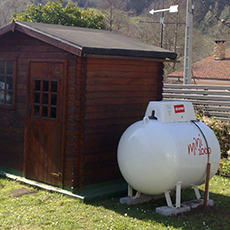
      1. Types of tanks: Outdoor: in an open space, such as a roof-top, a garden area, etc.
        Buried: hidden underground.
      2. Capacity: 1,029 Kg to 10,227 Kg. useful load.
      3. Installation: simple and economic, designed so you do not have to worry about anything. Adapted to the needs of each customer.
    • Piped: the tank is located in a common zone, in order to provide energy to a residential block, housing estate or town.Piped propane gas is supplied through an individual meter, which records each user's consumption. The meters are placed in a cabinet or appropriate room, which must comply with the current by-laws, so all users may easily access it to read the meters to control expense. The amounts consumed are paid by bank order.
      1. Types of tanks: Outdoor: in an open space, such as a roof-top, a garden area, etc.
        Buried: hidden underground.
      2. Capacity: 1,029 Kg to 10,227 Kg. useful load.
      3. Installation: CEPSA has a group of technicians who cooperate and advise architects, promotors and builders from commencement till completion of the works. The facilities for use of propane gas are simple and cheap, considered to adapt to their needs.


    Close
  • What must be done in the event of an accident?

    In the event of leakage or spillage:

    • Turn your back to the wind.
    • Cut off the leakage if possible.
    • Restrict access to the area.
    • Dilute by spraying water.
    • Keep all sources of ignition away and avoid electrostatic charges.
    • Do not smoke.


    In the event of fire:

    • Stand with your back to the wind.
    • Try to bring the fire under control.
    • Turn off the stopcock if possible.
    • Cool nearby, burnt equipment with water.
    • If the leakage is cut off, extinguish the fire with dry powder or sprayed water. If not, let it burn out in a controlled way.


    First aid

    • EyesRinse the eyes with abundant cold water for at least 15 minutes and seek medical aid as soon as possible.
    • SkinWet the skin with abundant cold water, remove impregnated clothing and quickly go to a doctor.
    • InhalationBreath in fresh air, use oxygen or artificial respiration, if necessary, and go to a health center as soon as possible.


    Close
  • Is there an emergency telephone?

    CEPSA has an emergency telephone available 24 hours a day to deal with any emergency or anomaly: 902 100 224.

    Close
  • What must be done with old gas bottles?

    If requested, CEPSA will provide a free gas bottle withdrawal service. Your usual distributor will also return the deposit when the used bottles are returned.

    Close
  • Is it obligatory to have the butane bottle checked?

    Customers are legally obliged to have the installation checked, pursuant to the Royal Decree in the Official State Gazette 1085/92, which is aimed at protecting your safety, that of your family and assets.

    Close
  • What advantages are there to hiring CEPSA gas bottles?

    CEPSA provides you the possibility of having a qualified installer check the installation for a reasonable fee, so you and your family may have full peace of mind.

    Close
  • Is checking of the installation by another company in the sector valid?

    Yes, any authorized technical service is valid for CEPSA supplies. If the review is performed by our technical service, CEPSA offers insurance coverage three times greater the amount you have.

    Close
  • Where can I get more information?

    If you wish more information, please call our customer care telephone 902 416 416.

    Close
Cepsa is a member of 'Confianza Online' and acts in accordance with the standards and principles of its Code of Ethics on E-commerce and Interactive Advertising